8. Coding and Solving Worded problems – Finding the Unknown with Multiple Variables
One of the types of coding and solving worded problem questions are those to do with unknowns of multiple variable, one of these is profit-and-loss type questions.
When students see profit and loss they will generally think of finance and complex calculations. This is not always the case. At a Year Eight level, profit and loss usually involves working out a purchase problem to find the best deal.
Profit and loss questions assess your ability to recognise and calculate the difference between money that comes in and money that goes out . To put it simply, profit is the difference between money going out and money coming in if the:
- difference is positive, it's a PROFIT!
- difference is a negative amount, it's a LOSS!
You know when you're dealing with a profit and loss question when the question involves a money-in and money-out process. This may be buying or selling. A sales process generates a profit or loss (on a simplistic level). For example, if you spent $10 on a pair of sunglasses and then you sold them for $15, how much profit have you made? You would have made $5.00.
Below is a three-step process in how profit is generated to aid in your understanding.
| Steps | Illustrated Example |
|---|---|
| Step One - Buying | You spend $100 buying 10 pairs of sunglasses. Therefore the sunglasses are $10 each. |
| Step Two - Selling | You sell the sunglasses at $15 each. |
| Step Three - The Difference | You've made $5 for every sunglasses you sold ($15 sales price less $10 bought price). Assuming that you've sold 10, you've made a profit of $50 (10 sunglasses x $5 profit). |
The other questions (not profit and loss), which involve variables follow a similar process as per the previous checkpoints.
Now, let's go through some example questions:
Example 1
Gwen, Lin and Stacey went to catch a taxi together back to their individual homes. Stacey recommended that they allocate costs according to the distances between their respective homes and the city. They agreed that the last person to be dropped off pay the total cost and they will figure everything out the next day.
Lin lives the furthest away so she was dropped off last. Next day, she told Gwen and Stacey that the total fare came to $77.80. If Lin has to pay $45.60 and her home is 3 times the distance between the city and Stacey's home, how much does Gwen have to pay?
(a) $15
(b) $17
(c) $16.8
(d) $32
(e) None of the above.
The next four questions are based on the following information.
Prime-cut beef is sold at five different butcher stores: A, B, C, D, and E. The figure below gives the mass and the price of the beef from each shop. Assume all the meat is the same quality.
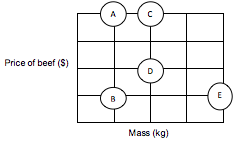
Which shop provides the worst value for money per kilogram of beef?
(a) Shop A
(b) Shop B
(c) Shop C
(d) Shop D
(e) None of the above
In which shop would you get twice the mass of beef as at shop A for half the price?
(a) Shop E
(b) Shop B
(c) Shop C
(d) Shop D
(e) None of the above
Suppose shop C sells their beef at $5 per kilogram. Which shop sells their beef for $2.50 per kilogram?
(a) Shop A
(b) Shop B
(c) Shop D
(d) Shop E
(e) None of the above
Suppose now that at shop C, x kg of beef cost a total price of $y.
How much per kilogram would be paid for the purchase at shop B?
(a) $ y/2x
(b) $5y/x
(c) $3x/2y
(d) $9y/2
(e) None of the above.
Key Rules to remember:
- To calculate profit you need to calculate total cost of what was bought and then subtract this from total sales.
- Quite simply, total money coming in less money that went out.
- If the money that came in was actually less than the money that went out – you have the opposite of a profit, a loss.
Now it's time to do your assignment.
- Download the assignment question here.
- Print it out or if you want to do it electronically, save it.
- Complete the questions to it.
- Then check the solutions on the video below.
- For the answers in text instead of video, download them here.
There are two videos:
Video 1 below shows the answer to Question 1.
Video 2 below, shows the old Q1 to Q10. Ignore Question 1 in the below video and if you want the solution to Q1, look at the above video.