15. Basic Trigonometry
Here are some rules to memorise for the exam when it comes to basic trigonometry.

- The internal angles of a triangle always total 180 degrees.
- The hypotenuse is the slanted part of a right-angled triangle
- A complementary angle is an angle, that with others, adds up to 90 degrees (a right angle)
- A supplementary angle is an angle, that with others, adds up to 180 degrees (a straight angle)
- Consider using Pythagoras’ Theorem when you see a potential right-angled triangle.
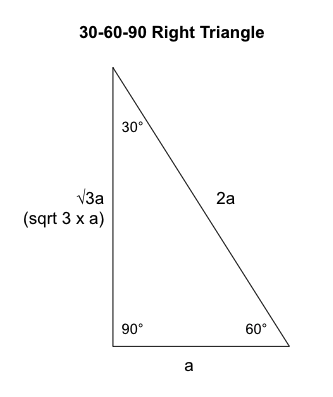
- There are certain dimensions when it comes to a 30-60-90 degree triangle (see below image). This is not covered in the video but is there for memorisation. In a nutshell, in a 30-60-90 triangle, the hypotenuse is 2 times the shortest side.
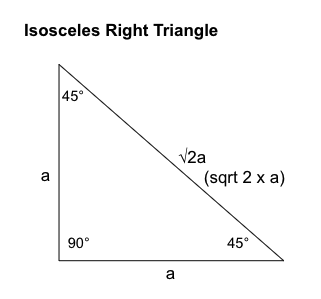
- There are certain dimensions when it comes to an isosceles right triangle (see below image). This is not covered in the video but is there for memorisation. In a nutshell, the hypotenuse is square root of 2 times the length of one side.
Here’s an example question (similar to an exam question).
Find the missing angle in this diagram

a) 6 tan(26)°
b) 34 sin(20°)°
c) 63°
d) 51°
This question is designed to give you far more information than you need in order to confuse you.
All we really need to know is that the interior angles of a triangle must always add to 180°- the circle, the lengths of the lines etc. are all irrelevant. Since we know that two of the angles are equal to 63°and 54°, we can express the sum of the angles as 63°+54°+ ?=180°. This simplifies to 117°+?=180°, and we can solve for ? by subtracting 117°from both sides to get ?=63°. Our answer is therefore (c).
The most important thing to remember when answering this question is that often more information than you need will be included in order to confuse you. If you know two of the angles in a triangle, you don’t need to use trigonometry or Pythagoras - you can use the fact that the three angles add up to 180°to solve for the last angle.
Example Question/s
Watch video for explanation of the following question/s:
What is the perimeter of the triangle?
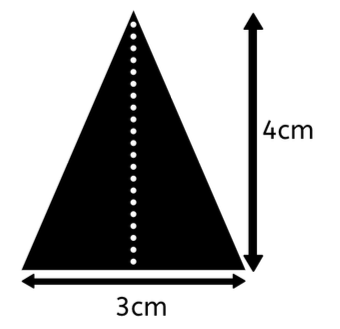
A 11 B 13 C 6 D 12 E None of these
If line AB is 6cm, line BF is 4cm and line FH is 3cm, what is the length of line CE?

A 3.6cm B 4cm C 4.4cm D 5cm E None of these
Key Rules to remember
- The internal angles of a triangle always total 180 degrees.
- The hypotenuse is the slanted part of a right-angled triangle
- A complementary angle is an angle, that with others, adds up to 90 degrees (a right angle)
- A supplementary angle is an angle, that with others, adds up to 180 degrees (a straight angle)
- Consider using Pythagoras’ Theorem when you see a potential right-angled triangle.
Practice time!
Now, it's your turn to practice. Before doing these practice questions, we recommend reviewing the next checkpoint as the subject areas are interrelated.
Click on the button below and start your practice questions. We recommend doing untimed mode first, and then, when you're ready, do timed mode.
Every question has two solutions videos after you complete the question. The first is a quick 60 second video that shows you how our expert answers the question quickly. The second video is a more in-depth 5-steps or less explainer video that shows you the steps to take to answer the question. It's really important that you review the second video because that's where you'll learn additional tips and tricks.
Once you're done with the practice questions, move on to the next checkpoint.
Now, let's get started on your practice questions.
10 questions
Take a Timed Test Take an Untimed Test