11. Linear Equations
Linear Equations
The first part in understanding linear equations is knowing what a cartesian square is.
A cartesian square has a Y axis and X axis. It has spaces where coordinates can be placed. Below is a Cartesian square.

What are coordinates?
Coordinates are points on the Cartesian square which come in this form (x, y).
In the diagram above, you can see that in the top left quadrangle, that the coordinates are negative, positive. This means that any point there will always be negative and positive e.g. (-2, 5). This point is plotted as Point A as an example.
What’s it used for and why do you need to know it?
First, you need to know what it is because its concepts appeared many exams. Its underlying principles are used in a lot of things – for example, GPS systems, Google Maps and vector illustrations using in computer graphics. It is a big part of mathematics and is often referenced in other parts of mathematics, e.g. the unit circle in trigonometry.
What’s a linear equation?
It’s an equation, that is, something which equals something else which if plotted with y and x axes will make a straight line.
What’s its structure?
It follows this form:


Reconstructing a Linear Equation
The exam is likely to test your knowledge of coordinates and what the possible equation should be. This will draw from your knowledge of what the elements are that make up a linear equation.
They may give you a graph with two coordinate sets where you might have to reconstruct the linear equation. This is how you can do it quickly.

So, what do you do?
Assess the what you are given. You have a Cartesian Square with who lines. Each line, if they aren’t the same, would imply that there are two separate linear equations. We are also given the coordinates for one of the bold solid line.
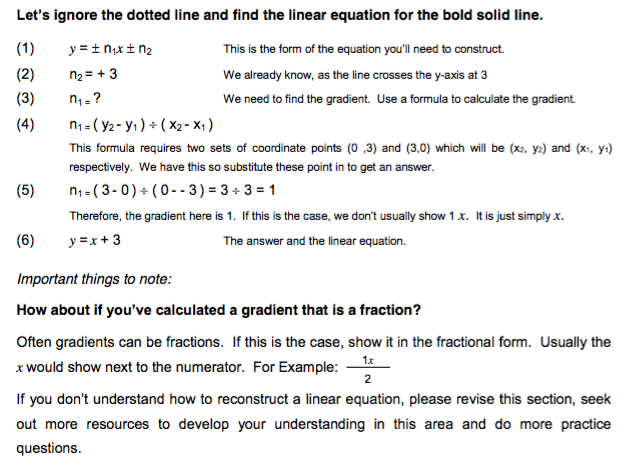
Substitution
This is a strategy you can use to check answers and, in some cases, find answers giving the exam is a multiple choice one. This strategy isn’t just limited to linear equations, you can use it a lot, including using it for algebra and also quadratic equations.
Substitution is basically putting a number in for x to find out what the y number is.
Example Question/s
Watch video for explanation of the following question/s:
Which equation could only be the equation of the graph?

A y = x + 2 B y = x - 2 C y = -x + 2 D y = -x - 2 E y = 2x - 2
Which set of coordinates lie outside the shaded area?
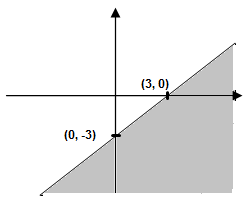
A (4, 0) B (0, -2) C (0, -6) D (5, -1) E (5, -3)
The equation of this graph is
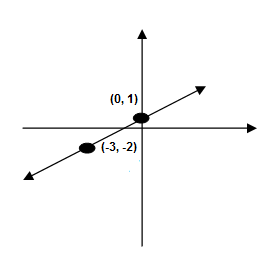
A y = 2x + 1 B y = x + 1 C y = 3x + 1 D y = 2x + 1/3 E y = 3x + ½
The gradient of the line is? (Let's see how keen your eye is - can you pick up the error? Check the video to find out what the error is)
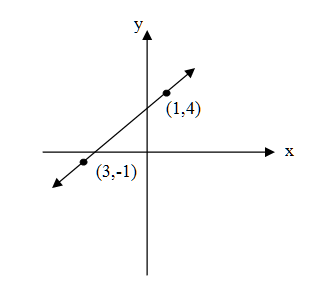
A -5/2 B 1/4 C 1/2 D 1/3 E None of these
Find the point of intersection of the graphs of y = 4x + 5 and y = 3x - 9
A (14, 33) B (-14,-51) C (14, -51) D (-14, 33) E None of these
Key rules to remember
- Know the coordinates and when x or y is positive or negative depending on quadrant.
- Remember the components of a linear equation: n₁x +/- n₂
- n₁ represents gradient
- n₂ represents the y-intercept
Practice time!
Now, it's your turn to practice.
Click on the button below and start your practice questions. We recommend doing untimed mode first, and then, when you're ready, do timed mode.
Every question has two solutions videos after you complete the question. The first is a quick 60 second video that shows you how our expert answers the question quickly. The second video is a more in-depth 5-steps or less explainer video that shows you the steps to take to answer the question. It's really important that you review the second video because that's where you'll learn additional tips and tricks.
Once you're done with the practice questions, move on to the next checkpoint.
Now, let’s get started on your practice questions.
10 questions
Take a Timed Test Take an Untimed Test