14. Distance Calculations
Distance Calculations
Distance is the measurement between one point and another point. Distance can be measured in different types of units and the common units used are:
- kilometre (km)
- metre (m)
- centimetre (cm)
- millimetres (mm)
The key with calculations involving distance is to compare with same base – apples with apples, not apples with oranges.
And, to do that, you need to:
- Multiply to get to the smaller unit.
- Divide to get to the bigger unit.
To restate, units and their relationship to each other are as follows:
- 10 mm = 1cm
- 100cm = 1m
- 1000m = 1km
In questions that test distance measurements, you may have to:
- Add distances (total distance)
- Calculate distances with other information
- Compare distances.
How to answer
The approach to answering these questions, in general is:
- Convert to the units of your answer.
- Calculate or depict what the question is requiring – use visual diagrams to help with problem solving or write out the mental process.
- Choose your solution.
Let’s see this in action now through examples.
Example Question/s
Watch video for explanation of the following question/s:
The next 2 questions refer to the following information:
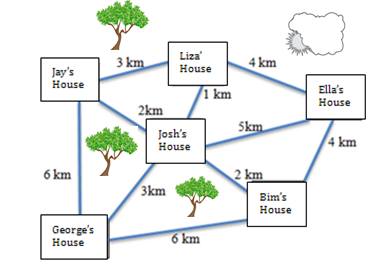
Liza went to Josh's house but having a stopover at Jay's House first. Then going back to their house using the shortest way. What is the total distance that Liza travelled?
A 10 km B 7 km C 5 km D 6 km
Liza, Jay, Ella, Bim and George will go to Josh's house. Who will travel the shortest distance going to Josh's house?
A George B Ella C Liza D Jay and Bim
Convert the following measurements to the units indicated:
- 3 m to mm
- 13 km to cm
- 13km to mm
- 75 m to km
- 650 cm to m
- 9,000 mm to m
- 850,000 cm to km
Key Rules to remember
- Convert to similar units – remember that 10 mm = 1cm, 100cm = 1m, 1000m = 1km
- Multiply to go down units, divide to go up units.
- Draw out diagrams to help make problem solving easier, especially for distance calculations.
Practice time!
Now, it's your turn to practice.
Click on the button below and start your practice questions. We recommend doing untimed mode first, and then, when you're ready, do timed mode.
Every question has two solutions videos after you complete the question. The first is a quick 60 second video that shows you how our expert answers the question quickly. The second video is a more in-depth 5-steps or less explainer video that shows you the steps to take to answer the question. It's really important that you review the second video because that's where you'll learn additional tips and tricks.
Once you're done with the practice questions, move on to the next checkpoint.
Now, let’s get started on your practice questions.
10 questions
Take a Timed Test Take an Untimed Test