7. Reading Graphs with Extension: Linear Equations and Parabolas
There are different types of graphs around:
- Pie
- Bar
- Line
Graphs have:
- Information that is plotted (2 dimensions) measured by:
- Y-Axis
- X-Axis
To find information:
- Locate the axis or both on which the information should be found (there may be more than 1).
- Once located, select your answer.
We're going to look at some graphs now…


Now let's go through some practice questions:
Q14 - Use the following graph to answer questions 14 and 15
The graph shows the number of hours a year 8 group spent doing their household chores for one week.

How many students did household chores for more than 7 hours per week?
A 16 B 22 C 18 D 26 E None of these
Q15 - How many students did household chores for less than 10 hours in the week?
A 18 B 24 C 30 D 16 E None of these
Q 56- Use the graph to answer questions 56, 57 and 58
The graph shows the price per piece of bath towel in different shops

Which shop gave the worst value for money?
A Shop B B Shop C C Shop D D Shop E E Shop A
Q 57 - Which two shops charged the same price per piece?
A Shops B and C B Shops A and B C Shops A and D D Shops A and C E Shops B and E
Q 58 - At which shop would you get three times the price of bath towel for the same piece as shop A?
A Shop C B Shop D C Shop A D Shop B E None of these
EXTENSION: LINEAR EQUATIONS & PARABOLAS
Cartesian Square
A Cartesian square has a Y axis and X axis. It has spaces where coordinates can be placed. Below is a Cartesian square.

What are coordinates?
Coordinates are points on the Cartesian square which come in this form (x, y).
In the diagram above, you can see that in the top left hand quadrangle, that the coordinates are negative, positive. This means that any point there will always be negative and positive e.g. (-2, 5). This point is plotted as Point A as an example.
What’s it used for and why do you need to know it?
First, you need to know what it is because its concepts appeared in the practice exams issued by Department of Education for the Selective Schools Examination in Victoria about eight times. Nowadays, its underlying principles are used in a lot of things – for example, GPS systems, Google Maps and vector illustrations using in computer graphics.
2.2. The Equation and Its Graphical Form
What’s a linear equation?
It’s an equation, that is, something which equals something else which if plotted with y and x axes will make a straight line.
What’s its structure?
It follows this form:


2.3. Reconstructing a Linear Equation
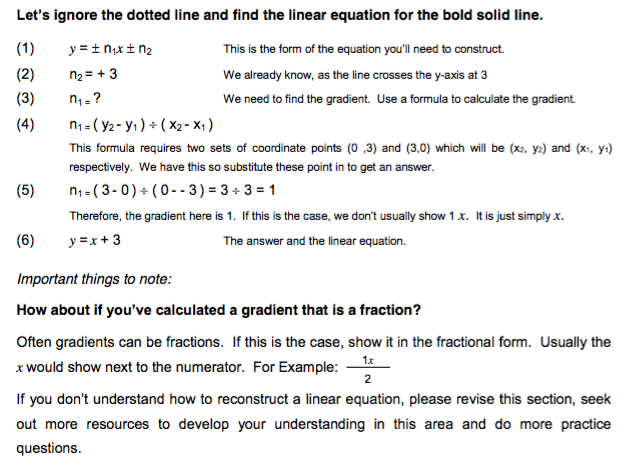
The exam is likely to test your knowledge of coordinates and what the possible equation should be. This will draw from your knowledge of what the elements are that make up a linear equation (as explained in Section 2.2 above).
They may give you a graph with two coordinate sets where you might have to reconstruct the linear equation. This is how you can do it quickly.

So, what do you do?
Assess the what you are given. You have a Cartesian Square with who lines. Each line, if they aren’t the same, would imply that there are two separate linear equations. We are also given the coordinates for one of the bold solid line.
2.4. Substitution
This is a strategy you can use to check answers and in some cases, find answers giving the exam is a multiple choice one. This strategy isn’t just limited to linear equations, you can use it a lot, including using it for algebra and also quadratic equations.
Substitution is basically putting a number in for x to find out what the y number is.
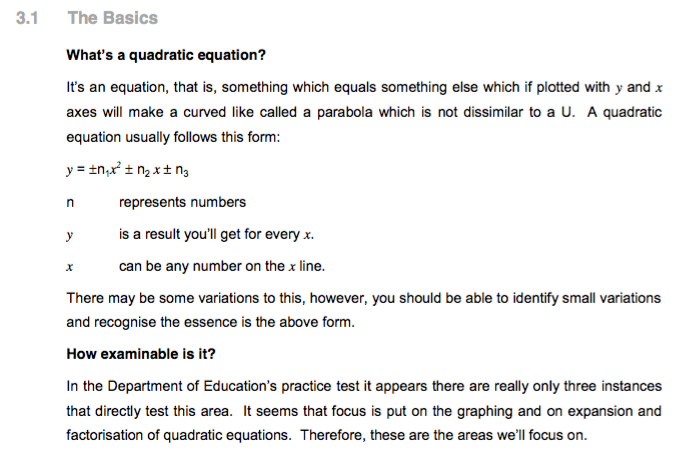
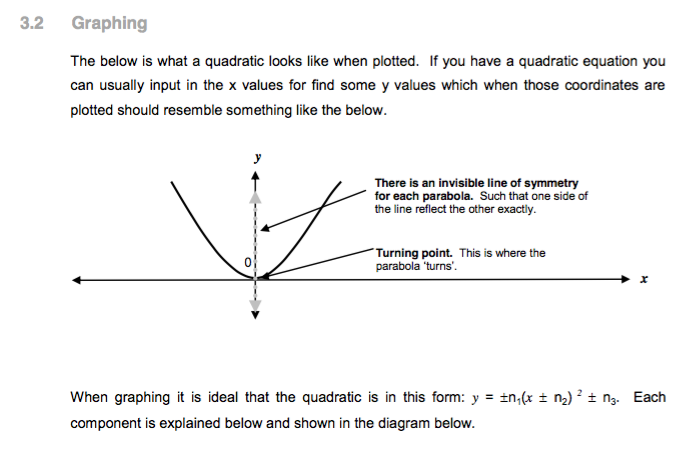
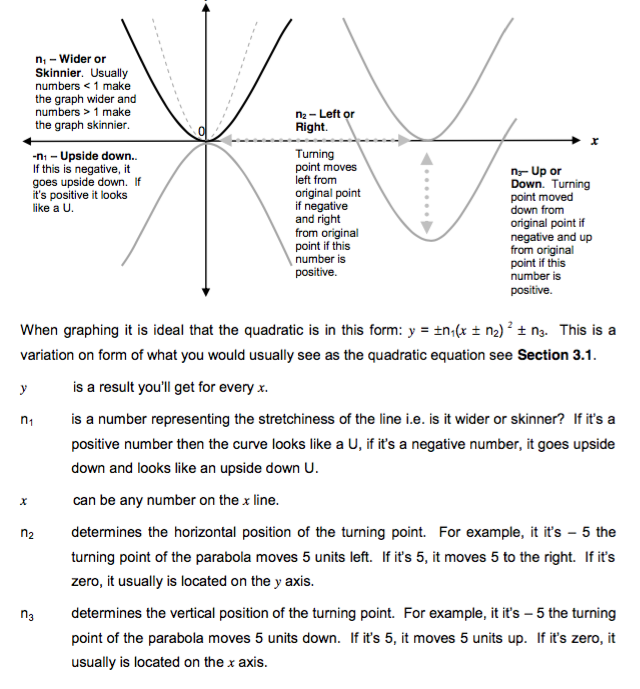
QUADRATIC EQUATIONS
Now it's time to go through some extension questions:
Q 32 - Which equation could only be the equation of the graph?

A y = x + 2 B y = x - 2 C y = -x + 2 D y = -x - 2 E y = 2x - 2
Q33 - Which set of coordinates lie outside the shaded area?
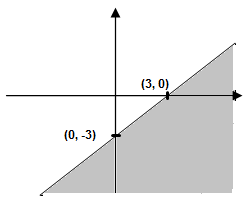
A (4, 0) B (0, -2) C (0, -6) D (5, -1) E (5, -3)
Q 34 - The equation of this graph is
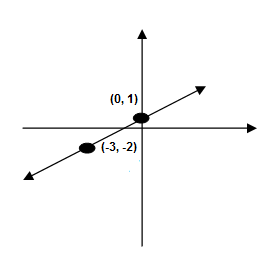
A y = 2x + 1 B y = x + 1 C y = 3x + 1 D y = 2x + 1/3 E y = 3x + ½
Q 17 - The gradient of the line is? (Let's see how keen your eye is - can you pick up the error? Check the video to find out what the error is)
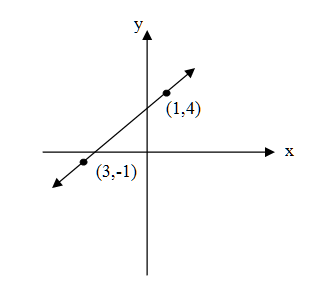
A -5/2 B 1/4 C 1/2 D 1/3 E None of these
Q 53 - The turning point of the graph could only be:

A (5, 6) B (-5, -6) C (-5, 6) D (5, -6) E (0, 5)
Q 55 - Find the point of intersection of the graphs of y = 4x + 5 and y = 3x - 9
A (14, 33) B (-14,-51) C (14, -51) D (-14, 33) E None of these
Let's now summarise what we've learnt today.
Now it's time to do your assignment.
- Download the assignment question here.
- Print it out or if you want to do it electronically, save it.
- Complete the questions to it.
- Then check the solutions on the video below or download the ANSWER KEY here.