10. Savings and Profit and Distance Calculations
SAVINGS AND PROFIT
-
Profit is when MONEY IN > MONEY OUT. So what is get is + MONEY.
- If MONEY IN < MONEY OUT you get a loss.
Savings is when MONEY SUPPOSED TO GO OUT > MONEY GOING OUT. So what you get is + MONEY SAVED.
Let's look at some illustrated examples of:
PROFIT
| Steps | Illustrated Example |
|---|---|
| Step One - Buying | You spend $100 buying 10 pairs of sunglasses. Therefore the sunglasses are $10 each. |
| Step Two - Selling | You sell the sunglasses at $15 each. |
| Step Three - The Difference | You've made $5 for every sunglasses you sold ($15 sales price less $10 bought price). Assuming that you've sold 10, you've made a profit of $50 (10 sunglasses x $5 profit). |
SAVINGS
| Steps | Illustrated Example |
|---|---|
| Step One – Original Price | 10 pairs of sunglasses are $100 originally. Therefore the sunglasses are $10 each. |
| Step Two – Discounted Price | There is a 20% discount on. 20% of $10 is $2, so each sunglass is $8 ($10-$2). 10 sunglasses = $80 with the discount. |
| Step Three - Savings | You've saved $2 for every sunglass you bought on discount ($10 original price less $8 bought price). Assuming that you've bought 10, you've saved $20 (10 sunglasses x $2 savings). |
DISTANCE CALCULATIONS
Distance is the measurement between one place and the other. Distance can be measured in different types of units such as:
- KM
- M
- CM
- MM
The key with calculations involving distance is to:
- Compared with same base – apples with apples, not apples with oranges.
-
To do that:
- Multiply to get to the small unit.
- Divide to get to the bigger unit.
-
Units and their relationship to each other are as follows:
- 10 mm = 1cm
- 100cm = 1m
- 1000m = 1km
-
You may have to:
- Add distances (total distance)
- Calculate distances with other information
- Compare distances.
-
The approach is in general:
- Convert to the units of your answer.
- Calculate what the question is requiring – use:
- Visual information
- Worded information.
- Choose your solution.
Now, let's do some example questions:
Zilla buys a phone that is marked 60% off. If she pays $200, what was its original price?
Adam buys 10 oranges for $2. At what price should he sell each orange if he wishes to make a profit of 25%?
Convert the following measurements to the units indicated:
3 m to mm
13 km to cm
13km to mm
75 m to km
650 cm to m
9,000 mm to m
850000 cm to km
Q 37 - Questions 37-38 refer to the following information:
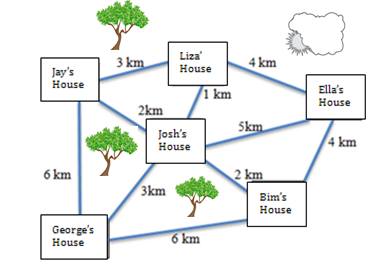
Liza went to Josh's house but having a stopover at Jay's House first. Then going back to their house using the shortest way. What is the total distance that Liza traveled?
A 10 km B 7 km C 5 km D 6 km
Q 38 - Liza, Jay, Ella, Bim and George will go to Josh's house. Who will travel the shortest distance going to Josh's house?
A George B Ella C Liza D Jay and Bim
Key Rules to remember:
-
Convert to similar units
- 10 mm = 1cm
- 100cm = 1m
- 1000m = 1km
Multiply to go down units, divide to go up units.
-
Profit is when MONEY IN > MONEY OUT. So what is get is + MONEY.
- If MONEY IN < MONEY OUT you get a loss.
Savings is when MONEY SUPPOSED TO GO OUT > MONEY GOING OUT. So what you get is + MONEY SAVED.
Now it's time to do your assignment.
- Download the assignment question here.
- Print it out or if you want to do it electronically, save it.
- Complete the questions to it.
- Then check the solutions on the video below or download the ANSWER KEY here.