1. Introduction
In persuasive/discussion writing, there isn't one correct answer to every question. But this is what makes writing challenging too.
This course will go through three types of writing (we'll called the ADI writing):
- Argumentative/Opinion on 1 side writing,
- Discussion Writing,
- Informative/Factual Report Type Writing (for PSO/Police Exams).
To make sure you know you're reading/learning the right area:
- Where an area is meant specifically for PSO/Police Exams (i.e. informative/factual writing) it will have the 'PSO/Police Exam' heading.
- Those doing PSO/Police exams should view all areas including those noted as "PSO/Police Exam"
- Those doing school based examinations should really look at the argumentative/discussion writing, although it doesn't hurt to look at the stuff under 'PSO/Police Exam' too.
Let's distinguish between the different types of writing:
Exam questions:
- What are the benefits and disadvantages of children having a four day school week?
- Do you think that the government should ban smoking everywhere? Argue for or against.
- Should all public transport be made free? Why/why not? Argue your point.
- Write a witness statement of the following incident. A man robs a liquor store and you are a witness.
- What are the gains and losses of working in the horse racing industry?
These are the four quality checks for argumentative/discussion writing:
- Have you addressed the question correctly?
- Are the arguments solid and carefully explained in relation to the question?
- Does it have a sense of order? E.g. counter arguments addressed?
- Is the overall tone of your argumentative piece reasonable?
Now let's look at an approach:
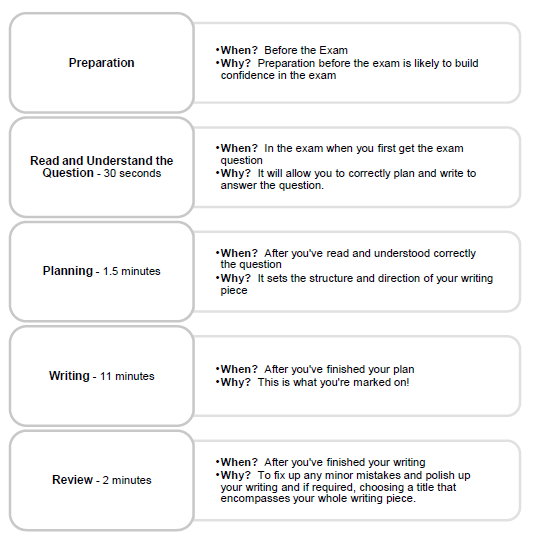
Links to editorials you can read as preparation:
http
http
In terms of what your writing is likely to be assessed against:
Order – does your ADI writing follow logically? Is there a logical step that people can follow from the beginning all the way to the end?
Arguments – have you chosen your arguments well and have you supported them?
Style – the writing is an objective sounding tone but the arguments have to be well written and clear. The strength of the writing will be in the rigour of the arguments.
The goal in writing a piece in an exam is about getting a well-written piece that answers the question and logically makes sense due to the time constraints. Your goal isn't to write a masterpiece, or even your best work if it means you don't complete it in time. Your goal is just to simply:
- Write what the exam has requested you,
- To a high standard,
- In complete form,
- Within the time frame provided.
Key Rules to remember:
- Have you addressed the question correctly?
- Are the arguments solid and carefully explained in relation to the question?
- Does it have a sense of order? E.g. counter arguments addressed?
- Is the overall tone of your argumentative piece reasonable?
Now it's time to do your assignment.
- Download the assignment question here.
- Print it out or if you want to do it electronically, save it.
- Complete the questions to it.
- Then check the solutions on the video below.
- To get the worded solutions/sample essays, download them here.
Sample essay solutions are here.