5. Structure – Main Event and Concluding
The main event is the 'climax' of the story and then follows through to the end (concluding). In more detail:
Middle (1 to 3 paragraphs)
This is where the action starts. Something unusual, unexpected, dramatic or important happens, or something is set in motion. It's where the "issue" or "problem" arises. This part of your story is where the conflict is; it is the climax. In this section, the main event occurs, which somehow disrupts the scene or situation where your story began.
The middle can be more than 1 paragraph. Usually you see it over 2 paragraphs.
For example:
I decide to try out his motorcycle when he's in the backyard chatting to his neighbour
and crash it into his front gate.
End (1 paragraph to 'wind-down')
This is the conclusion, or the resolution, of the conflict or major event of your story. It is the return to normality or the end of the action. It is usually satisfying, comforting or relieving in some way, but can also be mysterious (as in a twist, or a cliff-hanger).
For example:
I get taken to the hospital and my brother tells our parents.
Let's look at a story plan again to summarise the structure of a main event and the ending.
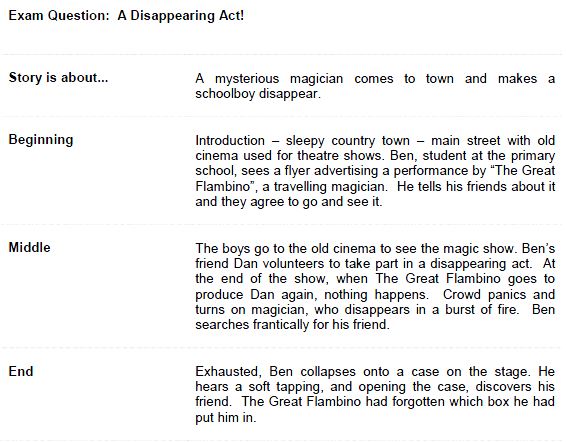
Now, let's write a main event and an ending to the stories we started in the previous checkpoint.
| Topic & Given Plot | Main event & Concluding (approximately 130 words) |
|---|---|
 |
A wombat who lives deep in the woods aims to cross the train line to the other side but gets scared often. |
 |
Competing in a rowing competition and practicing up to the lead up. |
 |
Attending a concert to see "Death Adda" and feeling helpless when getting caught in a mosh pit. |
 |
Visiting the city from the country and navigating through major landmarks with a map. Losing the map along the way. |
Key Rules to remember:
- The main event is the 'climax' of the story and then follows through to the end (concluding)
- Middle is around 1 to 3 paragraphs
- Ending is usually 1 paragraph to wind down.
Now it's time to do your assignment.
- Download the assignment question here.
- Print it out or if you want to do it electronically, save it.
- Complete the questions to it.
- Then check the solutions on the video below.
- To get the worded solutions/sample essays, download them here.
Solutions are here.