16. Letters in patterns
In abstract reasoning, you may get questions that include letters.
When you do see this, what you should note is that as abstract reasoning is non-verbal, when you do see letters, they are characters that represents an image or a part. Just like if a symbol were used instead.
To deal with these questions, the underlying pattern is most commonly one where the “letter” represents a certain non-verbal image and if joined with another letter, may modify the image.
To separate it out, letters in abstract reasoning question have:
- Common letter (one that is generally repeated) - make sure that if you have a group of letters, that you consider each one individually.
- Modifier letter (one that changes the look of the common letter).
Therefore, to answer these types of questions, you need to:
- Find common repeating letters.
- See associated repeating images.
- Associate 1 & 2.
- Find modifier letters.
- See how the modifier letters change the repeating images.
- Create a pattern statement and then use that pattern statement to find the answer.
Because abstract reasoning involves visual pattern detection, let’s apply this to the following question/s.
Example Question/s
Watch video for explanation of the following question/s:
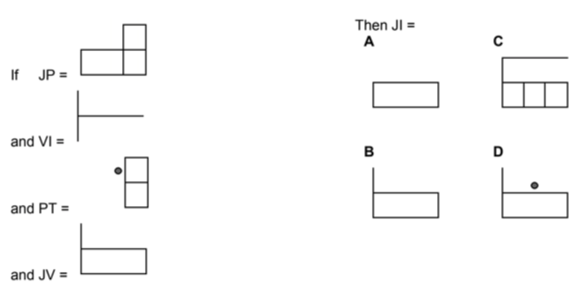
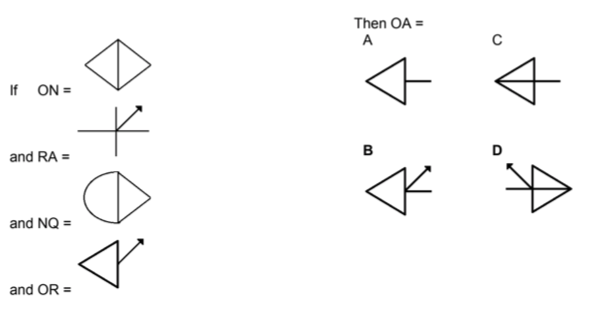
Key Rules to remember
- Look at what’s common and what’s not to find a relationship between the image presented and the letter.
- Then, look at the modifiers to see how the ‘original’ has been changed and then apply the pattern detected to find the answer.
Practice time!
Now, it's your turn to practice.
Click on the button below and start your practice questions. We recommend doing untimed mode first, and then, when you're ready, do timed mode.
Every question has two solutions videos after you complete the question. The first is a quick 60 second video that shows you how our expert answers the question quickly. The second video is a more in-depth 5-steps or less explainer video that shows you the steps to take to answer the question. It's really important that you review the second video because that's where you'll learn additional tips and tricks.
Once you're done with the practice questions, move on to the next checkpoint.
Now, let's get started on your practice questions.
10 questions
Take a Timed Test Take an Untimed Test